Overview
 An increasing volume of experimental and molecular dynamics (MD) simulation data has become available for
biomolecular systems. However, a persistent gap has long existed between low-resolution but highly reliable experimental
measurements and the high-resolution but computationally expensive, short-timescale MD simulations.
This limitation has hindered comprehensive characterization of biomolecular systems, their (mal)functions,
and the development of therapeutic interventions.
An increasing volume of experimental and molecular dynamics (MD) simulation data has become available for
biomolecular systems. However, a persistent gap has long existed between low-resolution but highly reliable experimental
measurements and the high-resolution but computationally expensive, short-timescale MD simulations.
This limitation has hindered comprehensive characterization of biomolecular systems, their (mal)functions,
and the development of therapeutic interventions.
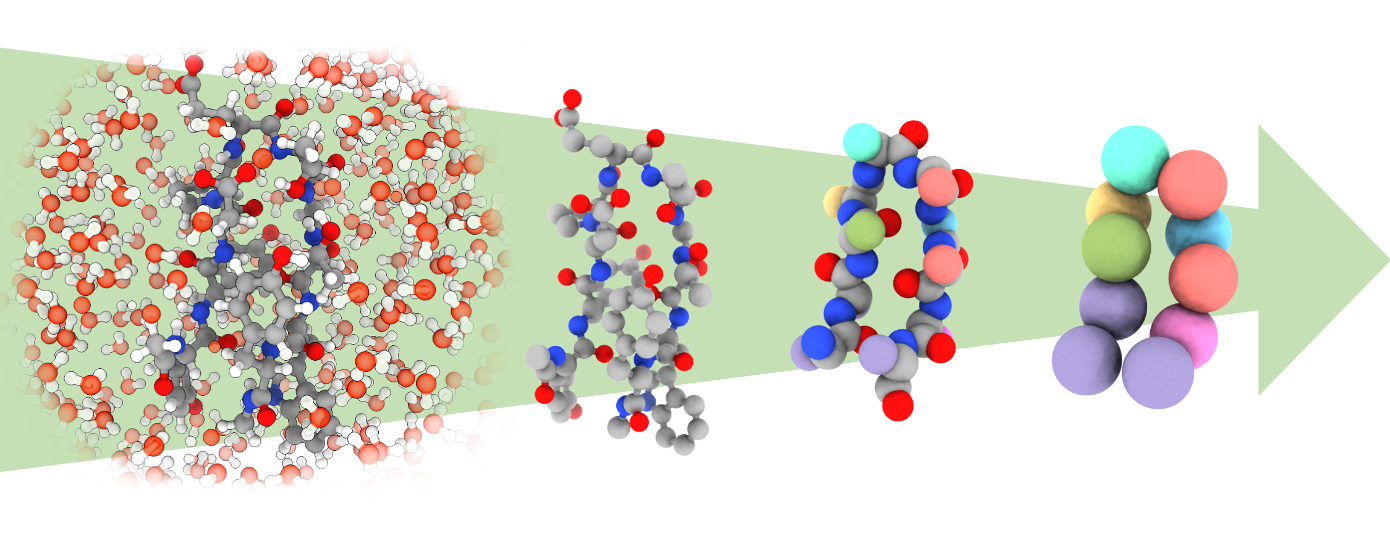
 To address this challenge, we develop a machine-learned coarse-grained (MLCG) model that is capable of routinely reaching
biologically relevant timescales while maintaining accuracy comparable to atomistic force fields. The model is
designed to be systematically refined using experimental data, enabling improved fidelity across scales.
By leveraging modern machine learning methods, we are working to establish such a model and release it
to the wider scientific community.
Beyond its immediate impact in biophysics, this work may inspire similar
advances in adjacent fields, including materials science.
To address this challenge, we develop a machine-learned coarse-grained (MLCG) model that is capable of routinely reaching
biologically relevant timescales while maintaining accuracy comparable to atomistic force fields. The model is
designed to be systematically refined using experimental data, enabling improved fidelity across scales.
By leveraging modern machine learning methods, we are working to establish such a model and release it
to the wider scientific community.
Beyond its immediate impact in biophysics, this work may inspire similar
advances in adjacent fields, including materials science.
For more information on our research, click on Our Research